Talaash
- Role
- Animator and narrative designer, Visual storyteller
- Year
- 2024–2025
- Client
- Thesis, BA (Hons) Interdisciplinary Expanded Design and Arts, Beaconhouse National University
- Scope
- Story and worldbuilding, Graphic novel, Character design, Illustration, Frame-by-frame animation, Storyboarding, A brass locket, as film memorabilia, Exhibition
Talaash follows Khalid, a father fractured by grief, as he moves through warped timelines in search of his daughter. My yearlong thesis, it blends metaphor with realism to reflect the emotional impact of collective trauma, told through a graphic novel, a frame-by-frame animated trailer and a brass locket.
The theme and story
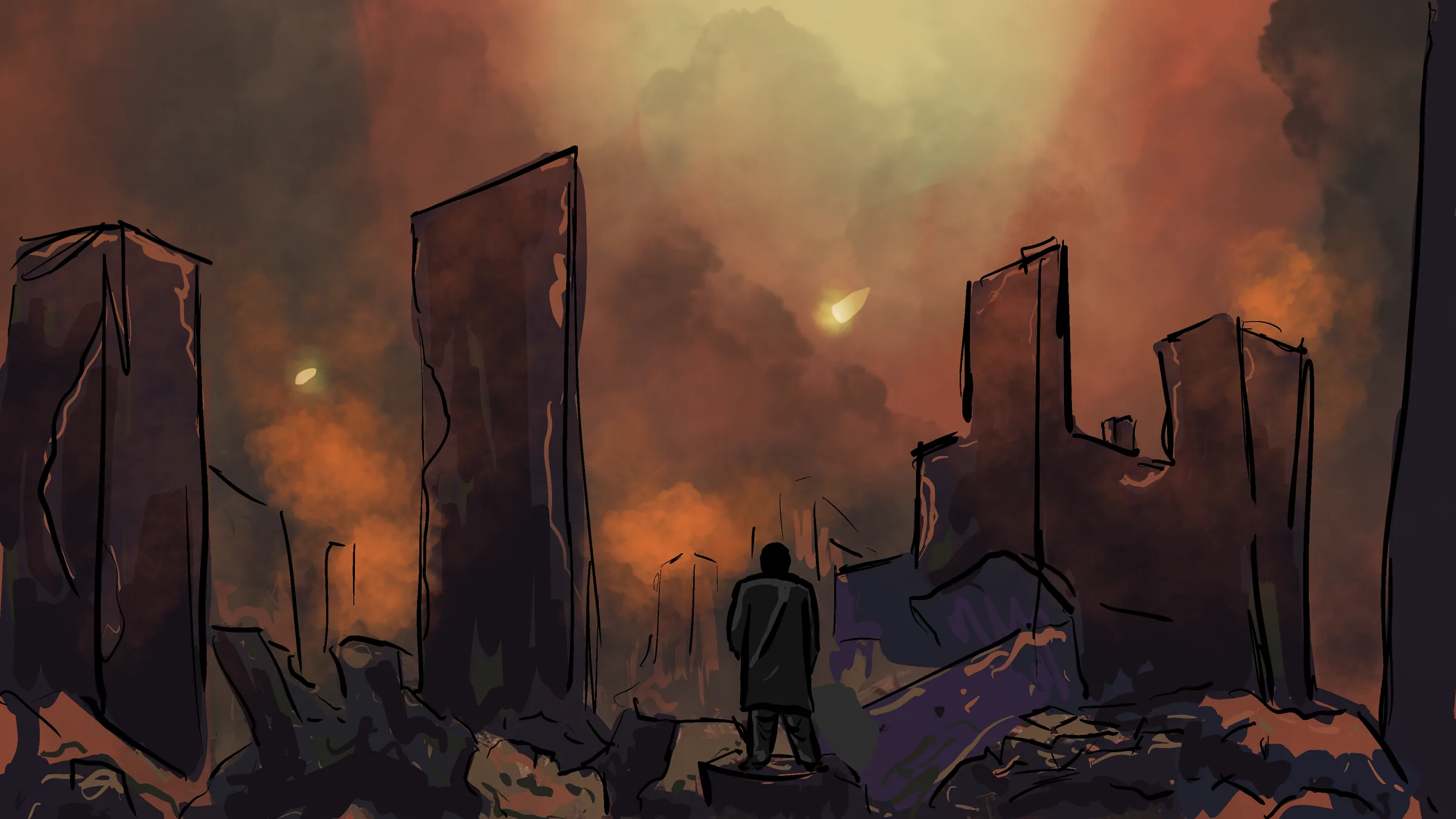
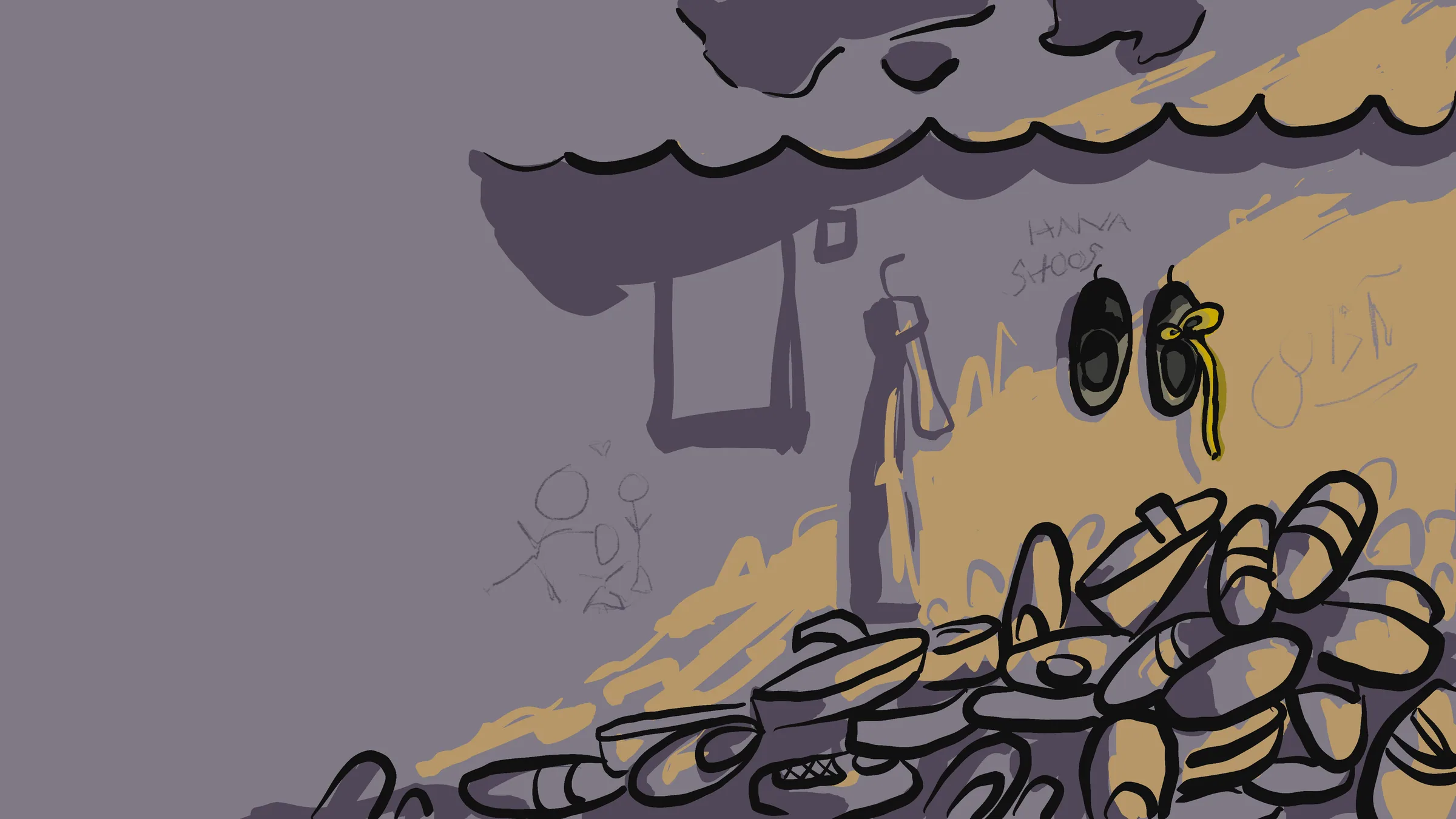
Talaash is Urdu for “search”. It began with one image: a father polishing his lost daughter’s shoes in a crumbling workshop, in a city at war. I didn’t start with a plot or characters, only that feeling of grief, and built the story around it. Visual first, theory second.
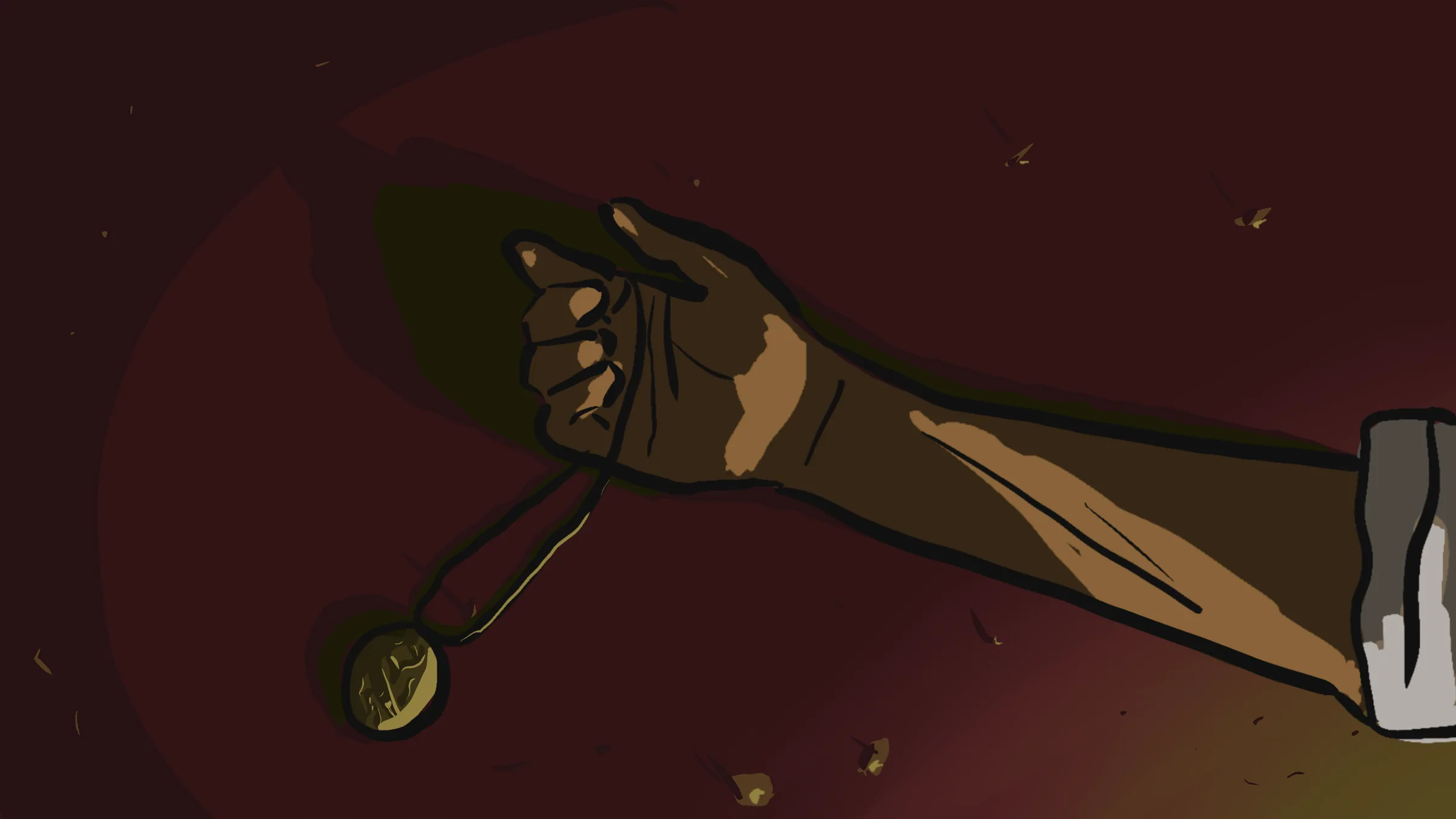
Khalid, a cobbler, has stopped mending soles. Each day he cleans one pair of small black shoes whose yellow laces have faded; they belonged to his daughter, Hana, lost in a bombing. Beside them sits a locket, an heirloom passed from hand to hand for generations. When he whispers her name, the locket pulses and time fractures.
He steps into a city that is pristine and too quiet, an echo of what could have been, watched over by Azafir, whose light makes everything too perfect. He chases Hana’s laughter through loops of memory until he must choose between the illusion and the dark. He steps into the dark, and comes home to his wife, Salma, who has kept the missing yellow ribbon. Together they sew it back into the shoe, mending what they can.
The locket is not a machine. It’s an emotional key, activated by grief rather than logic: Khalid doesn’t travel through time so much as get trapped in it. Four ideas hold the story together:
- Temporal fragmentation: trauma distorts time, blurring past and present into loops.
- Desensitisation: the numbness of constant exposure to suffering, in the Blob, which sees everything and feels nothing.
- Symbolic resistance: remembering and mourning as quiet rebellion, in the flickering Wisp.
- The observer effect: watching something changes it, as Khalid’s fixation on the locket reshapes his reality.
As systemic violence and genocide continue to erase lives while the world watches in silence, Talaash answers the burden of grief that is too often made invisible. It turns abstract statistics and distant tragedies into an intimate, felt experience.
The research ran from H. G. Wells and Thomas Hertog’s On the Origin of Time to Kafka, Edward Said, Susan Sontag and Judith Herman, and to films like Waltz with Bashir and Persepolis, which show that animation can carry emotional truth about memory and trauma. Early drafts satirised Orientalist stereotypes of the East. After critique I dropped the satire: it was clever, but emotionally disconnected, and the story returned to the grieving father at its centre.
You are not a drop in the ocean. You are the entire ocean in a drop.
The palette is limited on purpose: muted earth tones, gold for the locket and yellow for Hana’s shoelaces, a single warm colour in a grey world. This page is set in the same colours.
- Night umber#382818The war-torn city
- Tan#AD987BKhalid
- Khaki paper#D8C898Hana
- Mauve#BBA49ESalma
- Ink navy#182838Type and line
- Wisp violet#3B1F6EThe Wisp
- Moss#486848The Pulse
- Ember#E86828Letting go
- Locket gold#E8C547The locket, the laces
Artwork
Digital paintings from the graphic novel and the trailer: loose, hand-drawn linework, rough-edged like grief itself, and light that shows who is in control. Select any piece to see it full screen.
Character design
A family, and three forces that shape the world around them. The forces have no faces, mouths or voices, yet each says something: Azafir is a towering figure of light, for propaganda; the Blob a cracked, hollow observer, for the numbed crowd; the Wisp a flickering shadow, for those who resist and go unheard. They began as exposition and became ambient forces that shape the city itself. Select a character to see their pages.
Khalid
The father, a humble cobbler5′11″
- 46 years old
- Lives for his family, especially Hana
- Empathetic and selfless
- Worn out and tired
Hana
His daughter3′8″
- 8 years old
- An only child
- The light and heart of her family
- Stubborn
- Bright eyes full of curiosity
Salma
His wife5′3″
- 42 years old
- A supportive partner and loving mother
- Practical
- Modest
Azafir
The Manipulator15 ft
- A towering figure of light
- Controls the emotions and moral compass of the Blob
- Propaganda, made visible
The Blob
The emotionless observer5′8″
- Numb to society
- Emotionless and indifferent
- Fragile yet stubborn
- Sees everything, feels nothing
The Wisp
The shadow
- No voice or symbol
- Communicates through actions
- Too weak to touch the physical world
- Resistance that goes unheard
Animation
A one-minute trailer, animated frame by frame in Procreate Dreams with loose, hand-drawn linework, its environments tested in Unreal Engine for depth and light. It opens on the city from above, finds Khalid and the locket, and ends on the title. Press play for sound.
Every shot was boarded first: a wide Dutch angle on the broken city, an overhead close-up of the locket, low angles on Azafir, handheld fast cuts through warped alleys and an extreme close-up as the locket activates.
The book and the show
The graphic novel tells the story in ten chapters, from The Cobbler to After Math. At the degree show it sat on a cast plinth beside the framed artwork and the father’s locket. The locket was sketched in 2D, modelled in 3D, printed and cast in brass for an antique finish, so visitors could see, and hold, the weight of the story.
Time did not forget us. It only rewrote us.